

< News
Event report Future Legal Leaders Network - Oct 26
AI and Technology – A Tool or a Replacement?
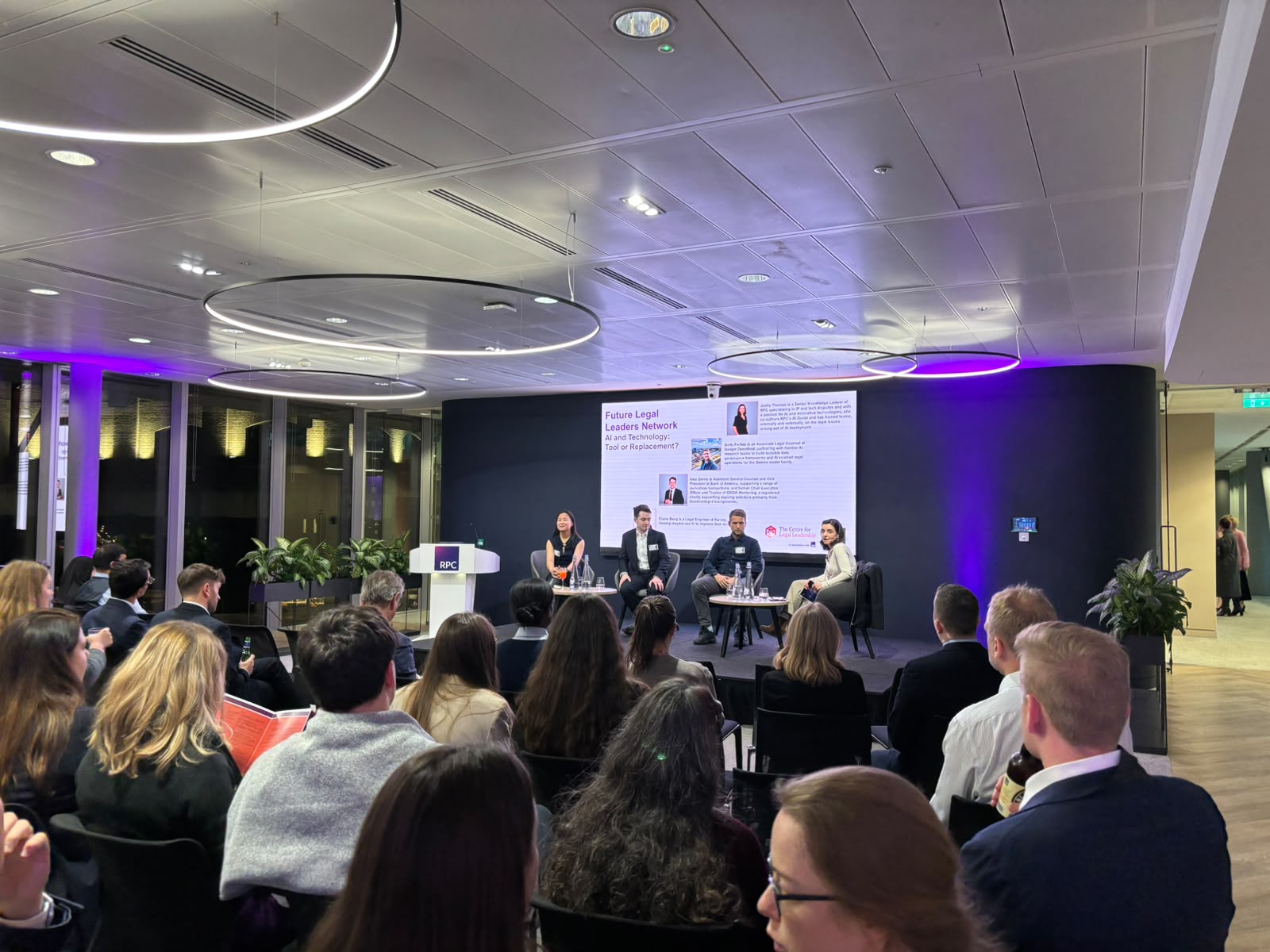
AI and Technology – A Tool or a Replacement? is a question on everyone’s lips and the one we put to experts working at the intersection of the in-house legal profession and cutting-edge technology at this October's event.
Joining moderator Joshy Thomas, an AI, IP & Tech Senior Knowledge and Innovation Lawyer at RPC, were:
- Andy Forbes, Associate Legal Counsel at Google DeepMind;
- Alex Denny, Assistant General Counsel and Vice President at Bank of America; and
- Elaine Deng, Legal Engineer at Harvey.
Is AI a tool or replacement?
Elaine: We, as humans, must verify and stand behind AI’s outputs. Yes, it can replace certain parts of the job, free up time and make our lives easier, but no AI provider will accept liability for advice provided by its technology. Somewhere along the line a person still has to put their name to it. So, AI is a tool, not a replacement.
Does AI change the value of juniors?
Andy: Yes. Juniors bring great AI fluency and that complements the expertise of the more senior lawyers in a team. Generally, juniors will be familiar with the technology having experimented with it as part of their studies. So, they bring knowledge of AI tools and how they can be applied and in turn uplevel the seniors in the team who may be a little bit slower to catch up with the technology.
What matters most in the AI era?
Alex: Three things. Firstly, attention to detail. With AI taking over many repetitive legal tasks, fact checking, proof reading and cross-checking have never been more important.
Secondly, creativity. AI models take information and use it to make predictions. They don’t apply human creativity, so qualities such as imagination, resourcefulness and the ability to devise novel solutions have real currency now.
And thirdly, commercial acumen. The in-house lawyer who understands their organisation’s goals and wider economic environment is better placed to support the overall strategy than the one relying on ‘black letter’ law.
Where can AI help junior lawyers?
Elaine: AI can make light work of a range of tasks for junior lawyers. Comparing, reviewing and drafting documents is one area. Research is another.
You no longer need to understand the intricacies of Venn diagrams or Boolean Operators as AI can locate and synthesise multiple research sources. You can schedule AI agents to check for regulatory changes. They can also be set up so they prompt you to do certain things, rather than the other way round.
How has the Bank of America encouraged AI adoption?
Alex: The training we have for AI is bank-wide and deployment is team by team. In legal, each team, such as technology legal, investment bank legal, global markets legal, etc. is working on its own individual AI projects. It’s siloed at times, but we’ve been successful in comparing how we're deploying AI between the different lines of business.
We've put together playbooks that talk about how we're using and overseeing AI. These enable us to support and, where necessary, supervise the adoption across the organisation safely and securely.
Where should juniors avoid AI?
Andy: Avoid using AI if it risks breaching confidentiality or legal privilege. Understand your organisation’s guardrails. Are you, for example, putting information into a public tool? If you are, the information may be used to train the tool, and this could breach legal privilege.
Also, steer clear of AI tools at the very final stage of submitting a document. They may drop in a citation that you weren't expecting. Similarly, just as AI tools can produce well-structured sentences that read persuasively, their content can also be lacking and/or contain hallucinations.
“At Burberry we use a simple formula: If we wouldn’t want our own personal data used in a given way, we don’t use anyone’s that way.”
Amanda Jackson, Legal Counsel, Burberry
What makes a trusted advisor?
Alex: Commercial acumen. AI models are predictive and work from previous information. But they’re not quite there in terms of reading situations. The trusted advisor is someone who can use AI competently and then interpret the outputs into a commercial, as opposed to purely legal, framework that is meaningful to, and easily understood by, the wider organisation.
What skills should junior lawyers develop?
Andy: The ability to spot where technology is most effective will pay dividends. Watch how your systems are working, how your teams are handling tasks and pick those that you can best convert to AI processes. Also essential is to know your organisation, its people and their personal challenges. AI is far away from being able to handle this, so this is an area you can add value in.
How can juniors protect boundaries?
Elaine: Use the Project Management Triangle, which comprises the three constraints of good, fast and cheap. You can’t deliver all three; the client must choose two of them. If the client wants it fast, offer alternatives.
For example, “I can't do it tonight, but I can do it by the end of the week.” Or “I can do a quick job tonight, but it won't be of the quality that I’d want to deliver.” If you have to say “no”, it’s OK to feel guilty. It’ll fade after a little while as, after all, we protect our boundaries for good reasons.
What can juniors do tomorrow?
Andy: Take one repetitive task and spend 45 minutes looking at how AI could semi-automate it. Record what worked and what didn’t and share your findings with your team.
Elaine: Build your relationships. Connect with fellow juniors and learn from seasoned legal practitioners. Think about the sort of network you want to build over the next 10 years.
“Your network is your net worth.”
Magdelena Markus, Regulatory Governance Officer, SEB
Alex: Experiment with technology. Play around with it and see what it can do for you. Compare contracts or board meeting minutes, for example. Remember, no learning is wasted – it’s all transferable.
Why attend a FLLN event?
CLL’s Future Legal Leaders Network (FLLN) events provide a relaxed setting for junior and mid-level in-house lawyers to get to grips with the big issues of the day.

They also enable you to build your network and reconnect with people you’ve met on your journey so far.
Kaela Clifford, Legal Counsel at Virgin Media O2, for example, was attending the October 2026 event with mentee and creative entrepreneur Kwabena Osie, who had recently completed the 20/20 Levels I Am Change personal development programme. Kaela also got to enjoy a drink with Magdelena Markus who she’d met at a previous CLL event.
“It’s a great opportunity to hear from experts on key topics and compare notes with our counterparts in other organisations.”
Kaela Cifford, Legal Counsel, Virgin Media 02
For Amanda Jackson (Burberry) and Maya Moodley (Liberty Specialty Markets), the event enabled two lawyers who trained together to catch up and share their experiences of in-house legal life.
“Events like this show that CLL is not just here for the senior in-house lawyers. They’re giving juniors a voice and a huge helping hand to become the legal leaders of tomorrow.”
Nick Lewis, General Counsel, Hexpress Healthcare Ltd
The next event is scheduled in Spring 2027 – May 20. You can pre-register here.